Welcome to the very first edition of the Hertfordshire “Authored by Schools” newsletter — your central hub for news, opportunities, and inspiration in school music education across the county.
Each term, we wish to celebrate the vibrant creativity and achievements of schools actively shaping their students’ musical journeys.
Let’s harness the power of music together—read on to learn, get involved, share and celebrate the musical heartbeat of Hertfordshire’s schools.
Haileybury Turnford
Our Primary School Outreach (PSO) programme continues to grow from strength to strength, inspiring young musicians across our feeder primary schools. Led by our PSO Music Lead, the programme currently reaches three local primary schools, with weekly or fortnightly sessions delivered to a range of year groups.
The primary music curriculum is rich and varied, encompassing vocal work, rhythm, notation and instrumental skills. Pupils take part in exciting activities such as becoming musical detectives—searching the classroom for rhythm flashcards—alongside coordination games, musical storytelling, singing and African drumming. These engaging approaches ensure that pupils are learning essential musical skills and developing a genuine love for music.The impact of this work has been hugely positive, and both staff and pupils at our partner primary schools value the opportunity immensely. Here’s what some of them have to say:
The music teacher’s work has encompassed both singing and instrumental music. She inspires the children to express themselves and to appreciate the role of music in their lives.”
“During her lessons, the music teacher prepares pupils effectively for Secondary School Music. She offers a wide range of activities, opportunities to play instruments, learn about the structure of an orchestra, begin reading music, and sing beats and rhythms.”
“I love the energy of the music Miss brings to school. She makes music fun and I really look forward to her lessons. I enjoy singing, and Miss has taught me how to listen to the beat and rhythm.” — Year 5 pupil
Successful PSO work relies on strong support from Senior Leadership Teams, and we are extremely fortunate to benefit from a highly supportive SLT at our school. Our outreach programme also extends beyond the Music Department, with the Art Department actively contributing to PSO activities—further enriching the creative experiences we are able to offer.
STAGS
Joint Celebration Day
Celebrating collaboration, confidence and the next generation of musicians
The orchestras at STAGS have been quietly growing, there has been a slow, but steady rebuild in the last few years and it is quite exciting to see! Pupils are turning up to Concert Band - our Junior Orchestra - eager to rehearse and build ensemble skills. This enthusiasm is now feeding successfully into our Senior Orchestra - for players of around grade 4 and above. We currently have around 35 players in this group. Balance still presents a challenge at times - there are 8 flautists and no bassoons! But they are steadily growing in confidence and over the past year have been ready to tackle more challenging repertoire. In fact, the greater the musical challenge, the stronger the attendance. It became clear that we needed to use this energy for something bigger than the Spring Concert.
With STAGS now part of a wider schools trust that includes four primary schools, an exciting opportunity emerged. One of the most critical moments in a young musician’s journey is the transition from primary to secondary school. This period can determine whether students continue playing, find a new teacher, join an ensemble and maintain the motivation to practise. Without the right support, many pupils lose confidence — and sometimes their connection to music altogether.
The Joint Orchestra Day had two clear aims: to inspire Primary students to see all the amazing benefits of playing an instrument through the transition and into secondary school, and to empower STAGS students to step into leadership roles as mentors and role models. Luckily, my Headteacher is incredibly supportive and immediately saw the benefits of such an event and supported in every way possible, including liaising with Primary heads to encourage support of the day. Four primary schools joined the initiative, bringing 20 young instrumentalists. We also invited around ten Year 7 students who play instruments but had not yet joined one of our ensembles, ensuring the day was inclusive and forward-looking.
The engagement and excitement from my two orchestras was amazing - they seemed to understand that this was a special event, created for them. Attendance at rehearsals was awesome and they all wanted to be involved in the day itself, asking constantly if someone who played their instrument was coming! We worked on repertoire in the weeks leading up to the day, and they helped me by checking parts I had arranged were suitable for lower grade players. A level Musicians also played a vital role in shaping the day - welcoming visitors, guiding them around school and even planning lunchtime activities including a lively ukulele jam session.
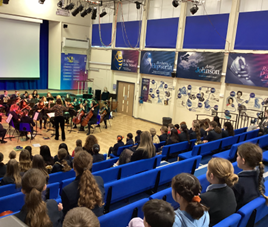
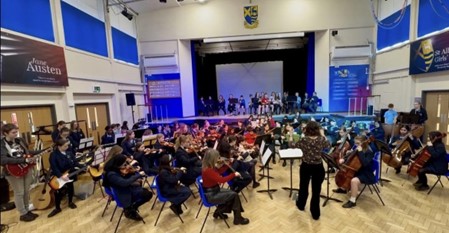
The day itself was absolutely manic but incredibly uplifting. We started by performing a short concert, explaining what each group was and showcasing the different genres of music that you can get involved in. This ranged from some fairly hefty Mozart to our folk band playing traditional hornpipes, to the Concert Band playing an arrangement of Dance Monkey. After allocating buddies and playing some orchestra games we split into sectionals. Beyond the music, something powerful was happening: primary pupils were experiencing life in a secondary school in a supportive, encouraging environment. They navigated classrooms, collaborated with older students and saw first-hand what their own musical futures could look like.
Coming back together after the break to try the three joint pieces was somewhat daunting - we needed to find space (and stands!) for around 80 players including three drummers, and then play together in time!
I had taken a chance on arranging a fairly sombre piece by Beethoven - but the performers totally understood the drama of this piece and, with my Year 11 drummer walking a Year 5 student through the timpani part, the piece was atmospheric and dramatic. For balance we then rehearsed Dance Monkey followed by Don’t Stop Believing - a perfect finale for our afternoon performance.
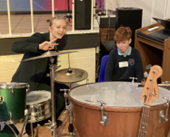
While initiatives of this scale inevitably bring challenges — including the reality that some schools reported having no current instrumentalists — the day underscored why such events are so vital. If we are to continue rebuilding and strengthening instrumental music, collaboration and outreach are essential. The impact on students at STAGS has been extraordinary and will be long lasting. The Music Lead at Beech Hyde Primary sent me a wonderful thank you message the following day which assured me that the day offered exactly what I intended. “It was such a tremendous experience for them. Being mentored during the day and then playing as part of a supportive orchestra gave them extra value and insight into playing their instrument within a group. The added bonus of being in a secondary school also gave them a window into what life in year 7 could be like.”
The Joint Orchestra Day celebrated growth, partnership and shared ambition. Most importantly, it was a fantastic reminder that when young musicians are given opportunity, encouragement and inspiration, they rise — together.
The Sele School
Keeping music alive: building a practical pathway from key stage 3 to key stage 4
When our Music provision was reviewed in November 2024, one of the immediate priorities was how to sustain participation at Key Stage 4. In a setting with a high proportion of learners with additional needs, many pupils were most successful in practical work, while confidence with extended written tasks and exam-heavy courses was often limited. As a single-teacher department with responsibility for the curriculum from Year 7 to Year 11, this required a review of the entire progression pathway.
The starting point was Key Stage 3. The curriculum was strengthened to prioritise practical and contemporary music-making, including regular performance, composition, and digital production. The aim was to build confidence early and enable learners to experience success through doing, developing independence and musical identity before making Key Stage 4 choices. Alongside this, schemes of work were designed to reflect a wider range of musical voices and traditions. Units such as Blues, Jazz, and Improvisation explore the cultural origins and significance of these genres, while a Year 9 focus on minorities and representation in the music industry helps learners understand music as diverse, relevant, and reflective of the world around them.
It quickly became clear that the existing Key Stage 4 pathway did not fully align with the strengths being developed at Key Stage 3. Within the first term, the decision was made to introduce the RSL Level 2 Certificate for Music Practitioners.
To ensure stability, the Year 11 cohort completed their GCSE course as planned. The Year 10 cohort transitioned from GCSE to the RSL qualification in the Spring term of the 2024/25 academic year. The intention was to provide a course that better reflected how learners were already engaging with music and to avoid a mismatch between their strengths and the demands of the qualification.
The vocational structure places rehearsal, performance, reflection, and improvement at the centre of learning, rather than relying on a high stakes, written examinations. This has created a clearer and more accessible progression from Key Stage 3.
Although the first cohorts are still working through the course, early cultural changes are evident. Learners are using rehearsal time more independently, taking ownership of repertoire choices, and approaching performance as a normal part of learning. Confidence has grown, particularly among learners who have previously been hesitant performers or who have found success difficult to achieve in more traditional academic contexts.
The change has also strengthened the day-to-day culture of music-making. Practice spaces are used more regularly, collaboration between learners has increased, constructive feedback has become an embedded part of performances, and the focus on improvement over time has supported resilience and persistence.
For schools where Key Stage 4 uptake is fragile, or where many learners benefit from a practical-first approach, aligning a contemporary Key Stage 3 curriculum with a vocational pathway can help sustain participation. Early experience suggests that continuity, relevance, and early success play an important role in keeping Music inclusive, active, and valued.
The Valley School
I am very fortunate to work in a school that values The Arts. I realise in these times that this is often the exception rather than the rule and I have worked in schools where music and drama were almost squeezed out of the curriculum in the pursuit of improved core data. (Hopefully the recent curriculum review will reverse this.) By building the trust of the SLT and governors showing what our students can achieve, we have been able to expand our offer and the results are really exciting.
For context we are a special school for students with learning difficulties. We have a high percentage of PP students (around 70%). All of our students are offered the opportunity to have small group instrumental lessons with one of our four fantastic peripatetic teachers from Hertfordshire Music Service. These are funded by the school and operate on a rotation basis. Due to the impact these lessons are having we have now doubled the number of teachers and hours we offer. By the end of KS3 those students who are really keen will continue and often opt for Performing Arts as a BTEC subject. Students also learn ukulele, keyboard and djembe in their curriculum lessons in addition to lots and lots of singing. This investment by the school has paid dividends across all aspects of a students’ experience and attainment.
Music lessons have positively impacted the wellbeing of many of our most vulnerable students. Students have built their confidence by performing in a concert or a more informal ‘busking’ event. Alternatively, they have enjoyed the space in the week to be creative on their own terms with a skilled facilitator. We have had one student who has gone from playing her flute from behind a curtain to standing centre stage and playing a solo. The culture of the school embraces the performing arts and the end of year school show has become a highlight of the school calendar. Every student is given the opportunity to participate either on or off the stage. The rehearsals are a hybrid of lesson times and lunchtimes with longer days for dress rehearsals in the week before the show. The positive impact that this has across the school community cannot be overstated.
We offer the Sounds of Intent qualifications to our Year 11s. These are recorded and assessed in the instrumental lessons and moderated by school staff. Our results have been fantastic with some students last year gaining a Level 2 award. This is the highest level achieved by any student in any subject across the school and is testament to the continued investment and emphasis placed on music by the whole school community.
By such high value being placed on the performing arts and music in particular, the school has developed an inclusive, creative, culture which impacts every aspect of school life. If you would like to discuss any this further, or perhaps would like some evidence with which to approach your SLT, please do get in touch.
Brookland Junior School
At Brookland Junior school, part of the Brookland Federation, music is everywhere. It is regularly played in class, during clubs and even on the playground! We have a weekly band practise in school and our Year 3's visit the local secondary school where they are able to explore playing instruments such as the Djembe drums and the electric guitar. Our Year 4's learn the recorder and our Year 3, 5 and 6 have the opportunity to play the glockenspiel while learning songs in their music lessons.
On January 20th, our school choir had an exciting day as part of the World's biggest school choir by performing at the O2 in London as part of the young voices. We sung a variety of wonderful medleys, including a Sea Shanty medley, a pop medley and songs from other cultures. The lead up to this performance involved our children giving up an hour of their time every week to practise and they really did our school proud.
On 3rd March, Brookland children from Years four , five and six attended an inter-school singing event along with other local Cheshunt primary schools and the Haileybury Turnford singers. The children became part of a large multi-school choir where they performed two inspiring motivational songs chosen and co-ordinated by the Herts Music service . Our group also put in an incredibly melodic, high-energy performance of I'm a believer from the Shrek movie. The audience were appreciative of their phenomenal efforts and all the children involved should be extremely proud of themselves and their hard work.
Woolenwick Infant and Nursery School
Stevenage Community Trust supports development of young musicians at Woolenwick
The Primary Music Strategy was launched in September 2023 as a legacy project to boost the long-term development of young woodwind instrumentalists in Stevenage.
Spanning both Woolenwick Infant and Junior schools, the strategy focuses on weekly musical instrument lessons on NUVO instruments which begin in Year 2 and then continue in Years 3, 4 and 5.
Helping to break the link between family income and musical achievement, the Primary Music Strategy is completely free-of-charge for parents and carers at point of access. There are currently more than 200 children under the age of 10 years-old who can read music notation on the treble clef and play a reeded instrument (NUVO’s DooD and jSax instruments).
We now have the capacity to create a Junior Wind Band at Woolenwick Schools, due to a very generous grant from the Stevenage Community Trust alongside Stevenage Councillors Coleen De Freitas, the Youth Mayor and the Deputy Youth Mayor. We will be purchasing 30 instruments as well as stands and music for the children to begin the next stage of the Primary Music Strategy in the Summer term.
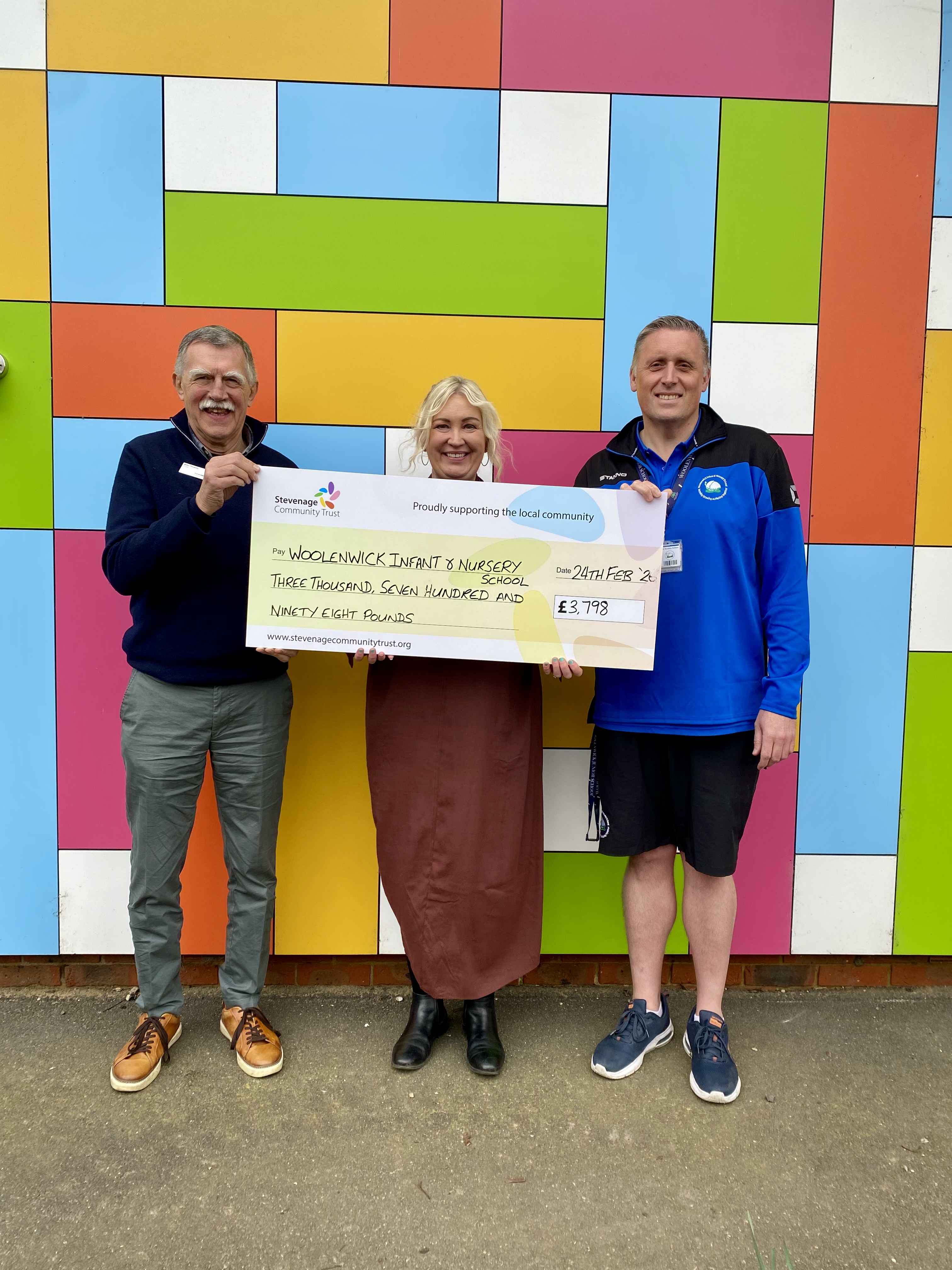
Pictured are Mike Phoenix, trustee of Stevenage Community Trust, presenting the cheque to Woolenwick Schools alongside Music Lead Sarah Todd and Executive Headteacher Richard Pallant.
Howard Burrell Memorial Award boosts young pianists
Colby from Elder Class was recently presented with a Yamaha piano, bench and stand by Hilary Spiers from Stevenage Arts Guild.
Woolenwick Infant & Nursery School were given the 2025 Howard Burrell Memorial Award in recognition of our 'exemplary work with Music education' and we used the award to fund the purchase of six electric pianos.
Stevenage Grange Rotary Club visit
Woolenwick Infant & Nursery’s Music Lead Sarah was invited to speak again at a recent meeting of the Rotary Club of Stevenage Grange.
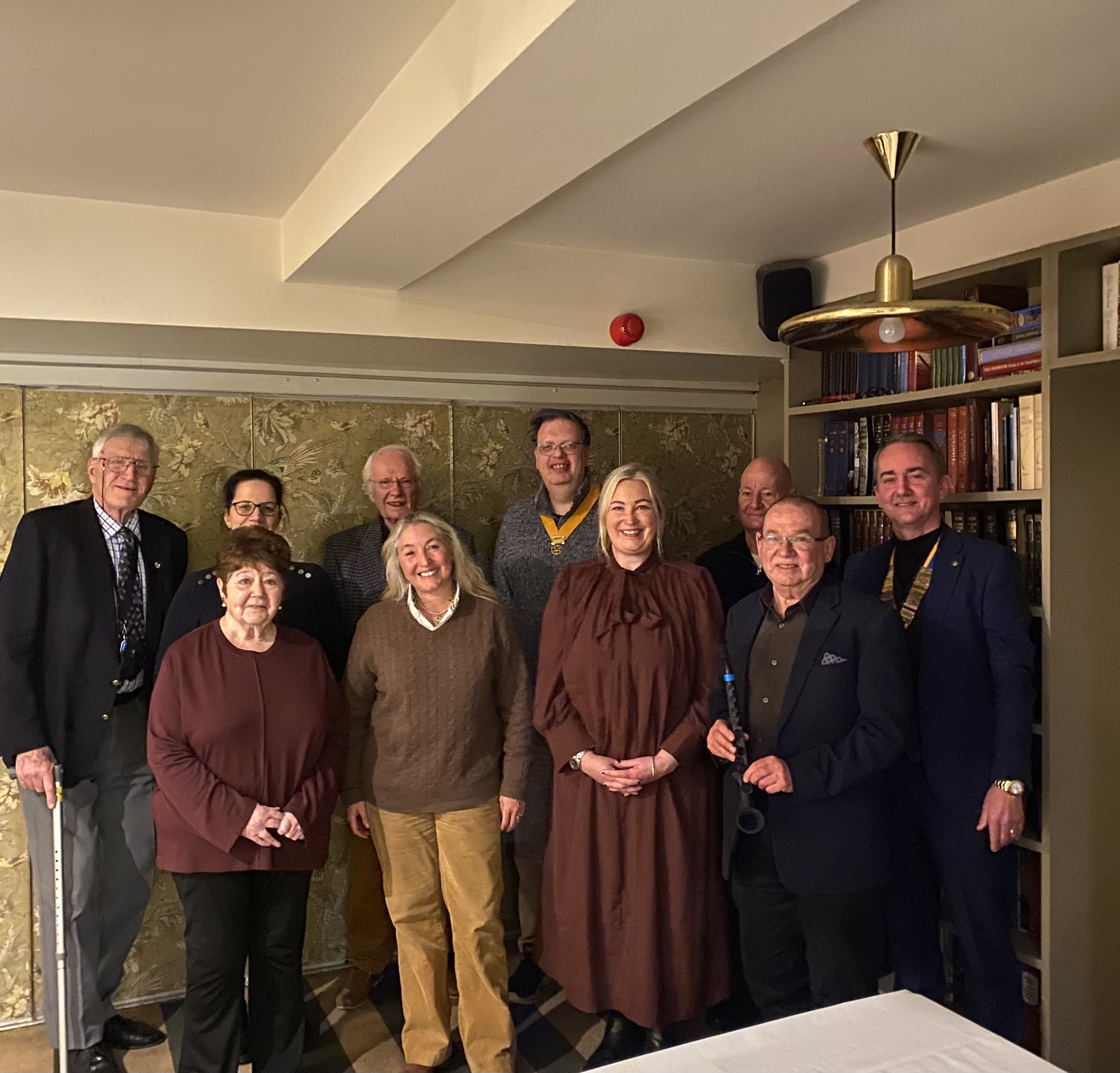
Sarah spoke about the enduring and positive impact of music education and The Primary Music Strategy and how it has benefitted our school's children. Sarah is pictured with Peter Tippett, President of the Stevenage Grange club and with the Rotary members present.